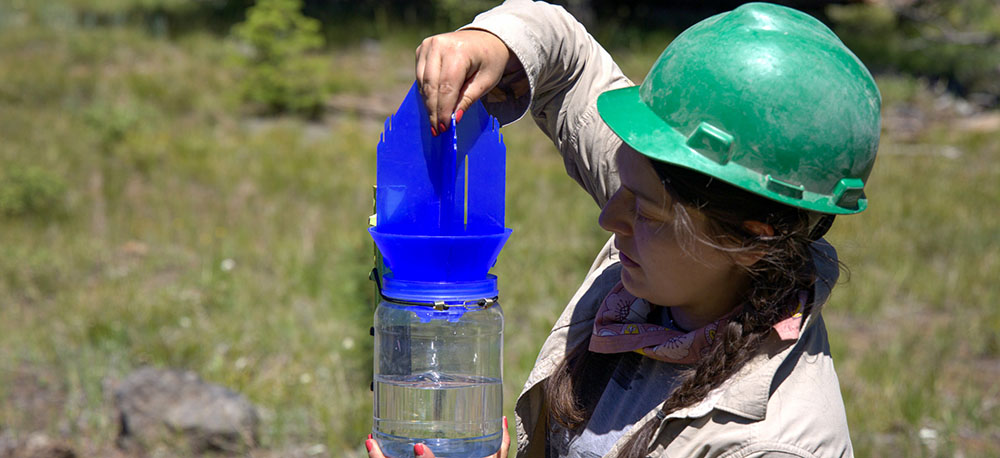
When Ashley Mertens heads into the dry forests of eastern Oregon, she's not just looking at trees. She's listening for buzzing.
Mertens, a graduate research assistant in the Forest Animal Ecology Lab, is investigating how forest management practices affect wild bee communities, and what she's finding could change how land managers think about the intersection of wildfire risk and biodiversity.
Her work comes at a critical moment. The dry forests of eastern Oregon face mounting risk of severe wildfire, the result of more than 150 years of fire suppression compounded by increasingly warm and dry summers. Land managers have turned to mechanical thinning and prescribed fire to address that risk. Mertens wanted to know: could these treatments be doing something more?
Early results suggest yes. Thus far, treated forest stands show higher bee abundance than untreated stands, with sites receiving both prescribed fire and mechanical thinning outperforming those receiving thinning alone.
Mertens' path to bee research began during her undergraduate years at Eastern Washington University, where she assisted a graduate student studying pollinator communities in the heavily fragmented Palouse prairie ecosystem. The experience let her weave together two longstanding interests: botany and the ecological responses of animals to disturbance and land management.
She later worked with the Idaho Department of Fish and Game and the Xerces Society on projects focused on the imperiled western bumble bee and Suckley's cuckoo bumble bee. This work deepened her appreciation for how much remains unknown about wild bees.
"They respond so readily to disturbance, they are critically important to most biomes in the world, and yet they remain surprisingly understudied," she said. "We are already seeing population declines in ecologically important species, while simultaneously knowing so little about their ecology. There is no shortage of interesting questions to ask."
National Pollinator Week, celebrated each June, is a chance to spotlight the vast and often overlooked world of native pollinators. The Oregon Bee Atlas has documented more than 700 native bee species in Oregon.
“From giant, fuzzy social bumblebees to small metallic green solitary bees, once you are aware of the diversity of the insect world, there's so much to see whenever you go outside,” Mertens said.
Mertens is also eager to shift the conversation beyond flowers. While diverse floral resources matter, she says nesting habitat is one of the most overlooked ways people can support native bees. Many species nest underground in exposed patches of bare soil, while others use cavities like rodent holes, leaf piles or spaces between rocks, and some seek out pithy stems or holes in wood.
"To go above and beyond for native pollinators, providing diverse nesting habitat in addition to floral resources is a great next step," she said.
Mertens credits the collaborative environment of the College of Forestry’s graduate programs as central to her growth as a scientist. "The other graduate students in my lab are my greatest support system and teachers throughout this process," she shared. "This research project and graduate program have tested me as a researcher and helped me grow in ways I had never anticipated before coming to OSU."
As bee season peaks across Oregon this summer, Mertens' work is a reminder that protecting forests from fire and protecting the creatures that depend on them go hand in hand.