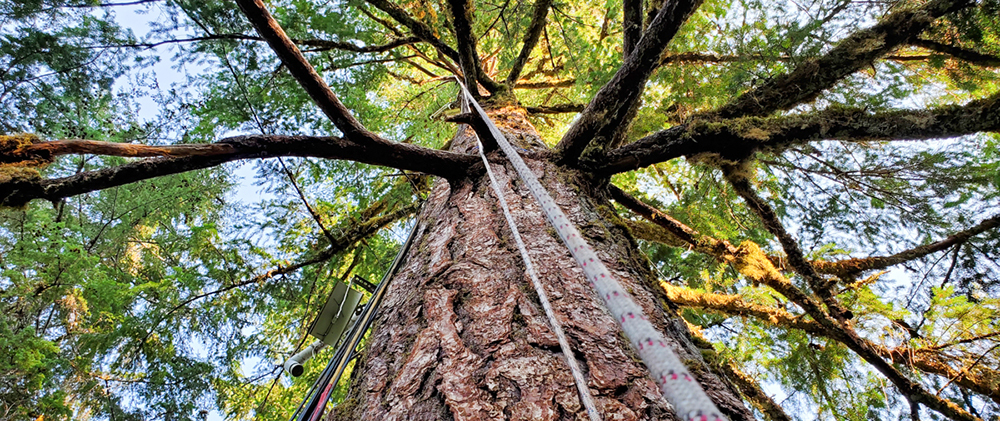
After a record-setting heatwave in 2021 scorched more than 1,000 square miles of upper tree canopy in the Pacific Northwest region, researchers from the College of Forestry set out to better understand how extreme heat impacts forest ecosystems. That’s when one particular tree in the H.J. Andrews Experimental Forest became the star of the show. Towering over 200 feet in the air and equipped with an array of sensors, an impressive old-growth Douglas-fir called the Discovery Tree stands at the center of this research.
The tree began as an educational project within a digital interpretive trail for K-12 students called The Discovery Trail. The H.J. Andrews Forest director, Mark Schultz, explained that the Discovery Tree is not biologically unique. What makes it special is its location. Positioned perfectly to connect with a nearby radio tower, the tree can transmit Wi-Fi to the digital trail and automatically send data back to researchers.
To help students visualize forest conditions and to better understand heat and drought stress in the upper canopy, the tree was fitted with temperature sensors and cameras that show how heat varies from the cool understory to the sun-exposed upper crown. But when the 2021 heatwave struck, those same educational tools became something far more valuable.
As temperatures shattered records across Oregon, the greater Pacific Northwest and parts of Canada, forests experienced a phenomenon known as leaf scorch. Leaves subjected to extreme environmental stress — particularly high heat — began browning, wilting and in many cases dropping prematurely. During the 2021 leaf scorch event, more than 1,000 square miles of tree canopy were damaged, according to research conducted by Professor Chris Still and his former graduate student, Adam Sibley.
In the weeks that followed, Still and Sibley turned to the Discovery Tree’s data to reconstruct what had happened high in the canopy. The tree’s thermal camera provided a rare window into leaf-level temperatures during the heatwave.
“The thermal camera on the Discovery Tree really helped us tell how hot the leaves actually got compared to the air during the heatwave,” Still said. “It's pretty unusual data to have that ability to see what the leaves actually experienced. Usually that's not a thing that’s measured.”
They found that the leaves reached 5-15 degrees Fahrenheit warmer than the surrounding air during the 2021 heatwave. In a larger research paper, Still and Sibley combined this finding with data from the Discovery Tree’s leaf-wetness sensors to challenge a previous theory that leaf scorch effects were solely caused by leaf drying and drought.
"There was an earlier paper published in a journal called Tree Physiology suggesting that the leaf browning and damage were related to the leaves drying out really quickly, framing it primarily as a drought die-off story. My co-authors and I wanted to correct that interpretation. We believed drought definitely played a role, but we argued that heat damage was the key factor. So we wrote a paper bringing together all of these lines of evidence to support that conclusion,” Still explained.
Demonstrating that extreme heat can severely damage trees without the influence of drought preceding a heatwave adds to growing concerns about climate change in forest ecosystems, especially as heatwaves continue to increase in frequency and intensity.
“There are atmospheric modeling studies that look at all the factors in the atmosphere that drove this heatwave and the interactions with the land,” Still said. “It's complicated, but generally, with continued warming, the models suggest there will be more and more extreme heatwaves like this.”
For foresters and woodland owners, those projections are not abstract. They shape decisions about what species to plant today in forests meant to thrive decades from now.
“I think one of the questions that foresters and woodland owners are asking now is, ‘What are going to be the more heat-tolerant species?’ You can already see that in the Christmas tree industry. They’re migrating to species like Nordmann firs, which come from hotter climates and tend to be more heat- and drought-resistant. The traits that give a tree resistance to drought also tend to make it heat-resistant, and vice versa,” Still said.
As climate change continues to intensify, research projects like those conducted on the Discovery Tree are becoming increasingly important. They help foresters better understand the effects of rising temperatures and make informed decisions about fostering heat-resilient tree species.