For decades, forest managers have relied on inventories collected every several years to guide decisions about planting, thinning and harvesting. But as climate change, wildfire, pests and shifting markets make forests increasingly dynamic, those periodic snapshots are no longer enough.
Oregon State University professor Temesgen Hailemariam is helping imagine what comes next.
As the Giustina Professor of Forest Management and director of the Center for Intensive Planted-Forest Silviculture, his research focuses on advancing and integrating emerging technologies and data analytics to transform how forests are observed, modeled and managed. His work brings together satellite imagery, terrestrial and airborne LiDAR, field measurements, sensor networks and artificial intelligence to create digital twin forests — continuously updated virtual replicas that mirror changing conditions in real forests. Rather than relying on inventories collected every several years, managers could continuously monitor changing conditions, anticipate future trajectories, evaluate alternative management scenarios and make more informed, adaptive decisions.
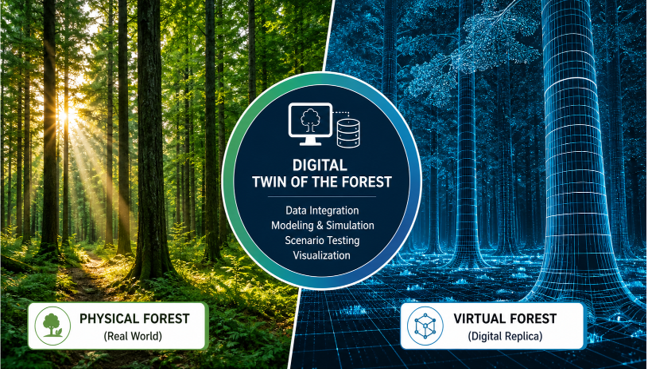
"Forests today face unprecedented complexity, rapid change and increasing uncertainty. The future of forest management therefore demands a fundamental shift from periodic assessments and static planning to intelligent, adaptive systems capable of continuous observation, learning, prediction and proactive management,” said Temesgen.
Digital twins are already used in manufacturing, aviation and health care to monitor complex systems and predict how they'll respond to changing conditions. Applied to forests, the technology could help managers anticipate wildfire and insect outbreaks, estimate future timber yields, evaluate carbon storage and compare the outcomes of different management strategies before work begins on the ground.
Collaborations with forest companies and public agencies have produced new approaches for continuously observing forests, improving inventories, estimating site productivity from remotely sensed data and predicting how forests develop over time. Together, those advances provide many of the building blocks for digital twin forests and the next generation of digital forest management systems.
“We're able to create living, dynamic digital representations of the forest because of decades of research in the Forest Biometrics and Measurements Lab,” said Temesgen. “That work to better measure forests, understand how they grow and predict their future has allowed us to integrate advances in sensor networks, remote sensing, AI and computing.”
The long-term goal is not to replace the expertise of foresters but to give them better information. By continuously integrating new data from the forest, digital twin forests could help managers respond more quickly to changing conditions while balancing timber production, wildfire resilience, carbon, biodiversity and other values that healthy forests provide.
“The future of forest management will not be defined by humans, AI, or autonomous machines alone, but by their collaboration, continuous observation, and effective use of data,” said Temesgen. “Human experience, judgment, and ethics combined with the speed, scale, and predictive power of AI can fundamentally transform how we steward forest ecosystems.”
Temesgen recently gave the keynote address at the inaugural International Congress on Forest Digitalization conference in Burgos, Spain. This conference brought together leading experts and innovators to advance technologies for sustainable forest management in a changing climate.