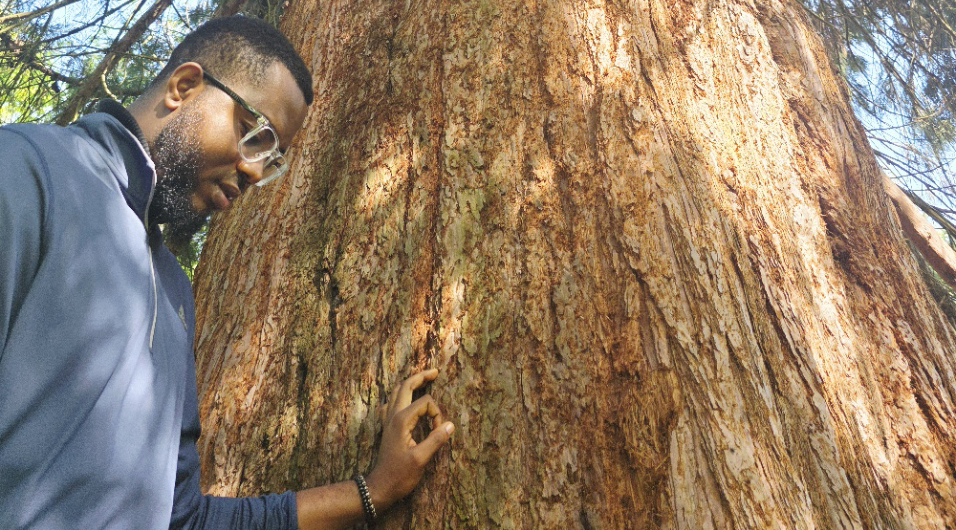
In the forests of Oregon, where commercial logging generates woody debris of low-economic value, researchers at Oregon State University are working to turn this debris into opportunity.
For Chukwuemeka Valentine Okolo, an applied economist pursuing his Ph.D. in OSU’s College of Forestry, the challenge is as much economic as it is environmental.
“I initially came into this research focusing on the efficiency of the Oregon Clean Fuels Program,” Okolo said. “The program is working, and it has been effective in driving lower-carbon fuels into the market through its credit system. But as I went deeper, I realized this is not just about fuels. It is about redesigning the upstream supply system to introduce new pathways that can feed into and strengthen the program.”
That system begins with forest residues — branches, slash and other byproducts left after timber harvests. OSU researchers, working under state directives like House Bill 3409, are studying how to convert that biomass into renewable diesel and gasoline through pyrolysis, a process that heats organic material without oxygen to create usable fuels.
The science is promising. OSU-led studies show forest residues can be converted into renewable fuels with measurable yields, while also producing byproducts like biochar and syngas that may improve economic viability. But scaling that process is far more complicated.
“The technology works,” Okolo said. “The real question is whether the business model works at scale.”
In addition, scaling the system comes with real obstacles, though not always where people expect. Transportation is often cited as a major cost; in the example that Okolo considered, the biomass could travel more than 200 miles to reach a processing facility, but it was found that transportation accounts for just 16 to 20 percent of the total system cost. The bigger expense is what happens once the material arrives: pyrolysis and refining make up 61 to 70 percent. The harder problem, Okolo said, may be sourcing the biomass at all. With roughly 88 percent of logging residue in western Oregon coming from private lands, building a reliable supply chain will likely require negotiating with many individual landowners, a challenge that is as much about policy and trust as it is about price.
“You may not negotiate just one contract,” Okolo said. “You may negotiate several. That’s where economics and policy intersect.”
Participation, however, depends on more than contracts and cost. Okolo said working with many individual private landowners introduces uncertainty around supply and long-term agreements. Researchers say those factors can make scaling biofuel systems as much a coordination challenge as a technical one.
His faculty mentor, Andres Susaeta, an assistant professor of natural resource economics, said those coordination challenges are central to the research.
“We’re not just looking at whether we can produce fuel,” Susaeta said. “We’re evaluating carbon intensity, cost and the entire supply chain — from the forest to the refinery.”
The research is part of a broader, state-funded effort to align with Oregon’s Clean Fuels Program, which aims to reduce the carbon intensity of transportation fuels. By replacing slash burning with fuel production, the project could reduce emissions while creating new markets for forest byproducts.
Kevin Lyons, the Wes Lematta Professor of Forest Engineering and a Principal Investigator for the project, emphasized the long-term potential.
“This is about more than just renewable fuels,” Lyons said. “How do we develop a robust business model that supports forest health, wildfire risk reduction and building rural economies around sustainable resources?”
For Okolo, the focus remains on understanding how these systems can function efficiently at scale.
“My work looks at how to make these pathways viable from a cost and policy standpoint,” he said. “There’s a lot of potential, but it depends on how well we can align the economics with the technology.”