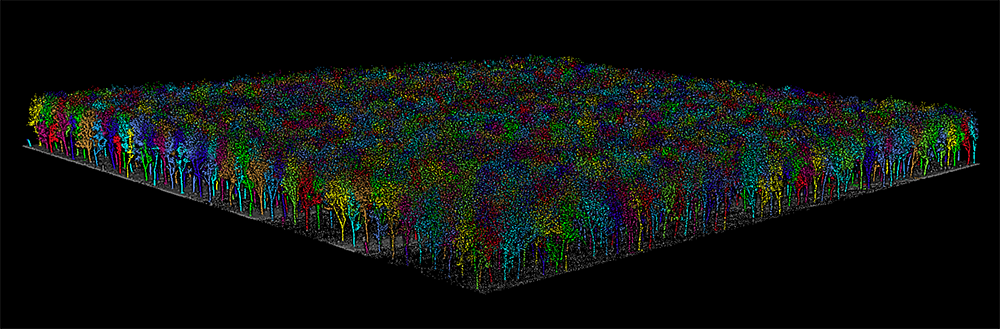
Researchers in the Oregon State University College of Forestry are advancing an international collaboration in Vietnam to improve blue carbon monitoring using advanced forest measurement technologies.
Blue carbon — carbon captured and stored by coastal and marine ecosystems — plays an increasingly important role in climate mitigation, restoration planning and emerging carbon markets.
Assistant Professors Heesung Woo and Jacob Bukoski are working with partners in Vietnam to explore how LiDAR-based 3D mapping and other digital monitoring tools can support more accurate, scalable and field-ready assessment of mangrove ecosystems.
Mangrove forests are among the most carbon-dense ecosystems in the world, storing large amounts of blue carbon while also playing a critical role in coastal protection and ecosystem resilience. But measuring forest structure, biomass and carbon in these complex environments remains difficult. Traditional field methods are often labor-intensive, time-consuming and difficult to scale across large restoration or conservation areas.
The Oregon State-led collaboration focuses on applying advanced sensing and digital forestry approaches to improve how mangrove ecosystems are monitored and evaluated. By integrating LiDAR-based 3D mapping with field data collection, the team aims to develop more efficient workflows for estimating forest structure, aboveground biomass and blue carbon-related metrics.
The broader goal is to support digital measurement, reporting and verification systems, or DMRV, that can strengthen restoration monitoring, improve transparency in carbon accounting and support future carbon project development. More reliable and accessible measurement tools could help communities, governments and conservation organizations make better decisions about restoring and protecting coastal forests.
The project is being conducted with collaborators in Vietnam, where mangrove restoration and coastal resilience are national priorities as communities face increasing threats from sea-level rise, coastal erosion and extreme weather. The collaboration also reflects a broader effort to build long-term research partnerships between Oregon State and Vietnamese institutions in forest technology, climate-smart monitoring and applied remote sensing.
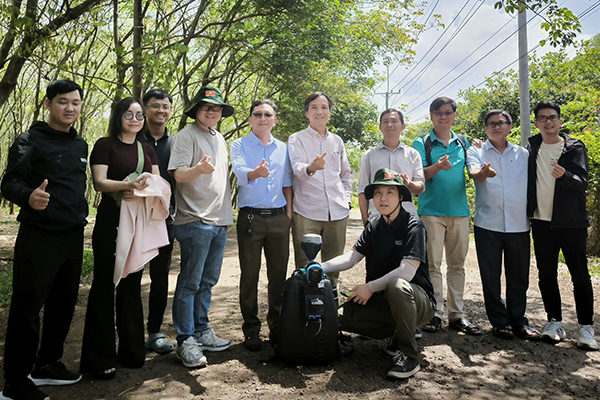
For Woo, the project demonstrates how practical forest technologies developed at Oregon State can be applied to global environmental challenges. His research focuses on field-deployable technologies, including LiDAR systems, sensor integration and AI-based mapping tools designed to improve forest measurement and decision-making in real-world conditions.
“Our goal is to build practical, science-based tools that can improve forest and ecosystem monitoring in real-world conditions,” Woo said. “Mangrove systems are especially important because they connect carbon storage, restoration and community resilience.”
The collaboration has also created opportunities to engage with research institutions and forestry stakeholders in Vietnam interested in applying advanced technologies for ecosystem monitoring. In addition to scientific outcomes, the project is helping establish a foundation for future collaborative research on blue carbon, LiDAR applications and digital forest inventory systems.
As the partnership continues, the team plans to expand field validation, refine data-processing workflows and explore how these methods can support long-term monitoring at larger operational scales.
The project highlights the College of Forestry’s growing role in advancing forest engineering, remote sensing and international research collaborations to address global climate and ecosystem challenges.
"Vietnam is a global leader in mangrove restoration,” Bukoski said. “It's exciting to be working with colleagues at Nong Lam University to better understand how the intersection of advanced forestry systems and carbon financing can further scale these successes."