As global demand for wood products continues to rise, College of Forestry researchers are asking a critical question: How can society meet future timber needs without causing harm to forests, biodiversity and climate stability?
That challenge is at the center of a new research effort led by Matt Betts, professor and Ruth Spaniol Chair in the College of Forestry's Department of Forest Ecosystems and Society, and former postdoctoral researcher Gianluca Cerullo, now a research associate at the University of Cambridge. The project, supported by an Oregon State University Internationalization Grant, brings together researchers from Oregon State, the University of Cambridge and the University of Hong Kong to create a global system for measuring the environmental impacts of wood production and trade.
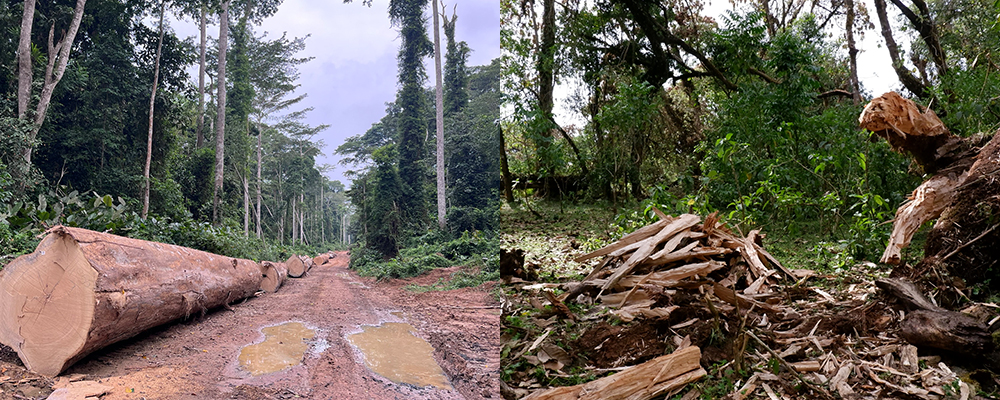
“There are more than 8 billion people on the planet, and demand for wood is expected to increase sharply over the coming decades,” Betts said. “We need better ways to understand the true environmental costs of how and where wood is produced.”
Forests worldwide are already under pressure from logging and land-use change, yet existing systems often fail to account for the full biodiversity loss and carbon emissions linked to timber harvesting and international wood trade. As a result, consumers and policymakers may not realize how wood consumption in one country can drive ecological impacts in another.
“Often local efforts to reduce wood production, especially in the temperate zone, can result in increased harvests in other, more biodiverse countries,” Cerullo said.
The collaboration recently convened at the University of Cambridge, where Betts met with Cerullo, Professor Liqing Peng of the University of Hong Kong, Professor Andrew Balmford of the University of Cambridge and Francisco d'Albertas Gomes de Carvalho, a postdoctoral scholar at Oregon State co-supervised by Betts and Cerullo. Together, the researchers refined the methods that will underpin the project and identified opportunities to collaborate with universities, non-governmental organizations and industry partners.
Cerullo and Betts plan to improve upon two existing scientific tools: one that estimates how forest management affects wildlife extinction risk, and another that measures the carbon impacts of timber harvesting. Rather than treating all forests alike, however, the researchers will compare multiple forestry systems — including plantations, selective logging, clear-cutting and retention forestry — to better understand how different practices affect habitat, carbon storage and forest recovery. Using large ecological datasets, forest inventory information and machine learning, they plan to create detailed global maps showing where different forestry practices have the greatest environmental risks.
Cerullo said the project is designed to link ecological impacts to global wood supply chains and help decision-makers navigate complex trade-offs.
“Forestry provides major economic benefits, but we also need to understand the long-term consequences of different production systems and locations,” Cerullo said.
The research also aims to trace how timber moves between countries and identify where the biodiversity and carbon “footprints” of wood products are actually occurring. This would allow governments, companies and conservation groups to better understand how trade policies, tariffs, recycling, illegal logging or increasing demand for mass timber and bioenergy could affect forests worldwide over the coming decades.
The proposal also has a strong policy and outreach component. The researchers plan to work closely with organizations such as Trase, the World Resources Institute and the Science Based Targets Network so the new tools can help guide corporate sustainability reporting and international forest policy. In addition, they plan to create a board game to help non-scientists understand the trade-offs between wood production, biodiversity conservation and climate impacts.
“With its interdisciplinary faculty and new computing resources, the College of Forestry is well positioned to lead a multi-institutional effort to enable humans to successfully coexist with the other nine million species on the planet,” Betts said.