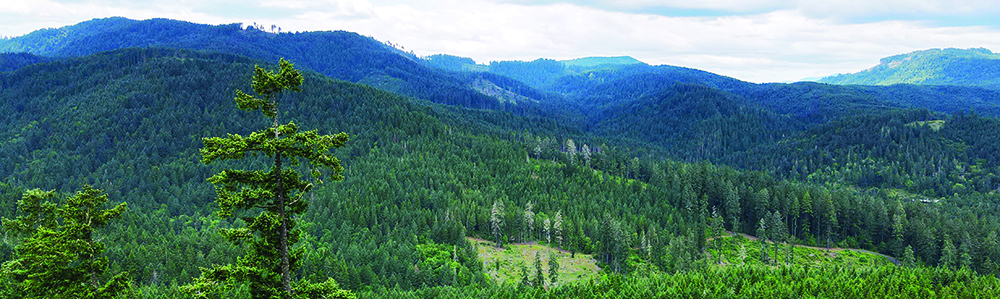
For most people, 100 years is more than a lifetime. For a forest, it is only a moment. In 1926, when Oregon State first acquired the original 80-acre parcel that would later expand into the current McDonald-Dunn Research Forest, the landscape was heavily cut over — a far cry from what visitors see today. A century later, that same landscape has been transformed into the flagship forest of the university’s statewide network, offering a powerful illustration of what long-term, intentional stewardship can achieve.
Over the decades, the McDonald-Dunn has grown alongside the College of Forestry itself. Through additional donations and acquisitions, it now spans 11,500 acres in the Coast Range foothills northwest of Corvallis. It is a place where research, education, active forest management and public connection intersect — a living laboratory where students and scientists study sustainable forestry while demonstrating how economic viability, ecological health, and social and cultural values can coexist across a landscape that welcomes more than 200,000 recreational visitors each year.
“Forestry is one of the only large-scale land management strategies compatible with recreation. We want people to see what a sustainably managed forest that supports both conservation and wood production can look like.” – Holly Ober, associate dean for science outreach
As conditions have changed, so too has the forest’s role. Climate change, evolving research needs and shifting public expectations have reshaped how forests are managed and understood. In response, the College of Forestry launched a comprehensive, collaborative effort in 2020 to update the McDonald-Dunn’s management plan — the first major revision since 2005. Finalized in late 2025 for implementation beginning January 2026, the plan arrives at a symbolic moment: the 100th anniversary of OSU’s first research forest acquisition.
“Since the first parcel was acquired as a mostly cutover expanse of land in 1926, the McDonald- Dunn Forest has been intentionally shaped by a century of active management, which in turn has informed how we think about sustainable forestry today,” said Holly Ober, associate dean for science outreach and leader of the planning process. “If history has taught us anything, it’s that change is constant — and this plan’s adaptable design helps ensure that, even as conditions shift, the forest can continue advancing its mission.”
The plan, developed over three years with input from faculty, students, Tribal partners, community members, recreational users and state and county agencies and nonprofit organizations, provides an adaptive framework to guide decision-making. It reflects an understanding that successful stewardship must be flexible, informed and inclusive of multiple values to support the dynamic nature of forests and all that depends on them.
The plan also reaffirms the McDonald-Dunn Forest’s role as an actively managed, financially self-supporting landscape that balances research, hands-on learning, ecological resilience, sustainable wood production and public access. In doing so, the plan aims to expand opportunities to restore sensitive ecosystems and to study climate resilience, older forest conditions and long-term forest management strategies.
The plan also looks further back in time, recognizing that OSU’s 100 years of management represent just one chapter in a much longer history of intentional care for the landscape. For generations before Tribes were forcibly removed from the region following the Willamette Valley Treaty of 1855, the forest was actively tended by Indigenous peoples for many uses. That stewardship was later disrupted by settlement, the exclusion of cultural burning, and increased logging and replanting, including the widespread use of non-dominant species such as Douglas-fir. The new plan calls for expanded partnerships with Tribal nations and a renewed focus on ecological restoration, reconnecting contemporary research and management with Indigenous Knowledge and long-term stewardship.
“Managed forests provide far more than wood,” Ober said. “They support biodiversity, store carbon, offer recreation and cultural value, and help communities adapt to climate challenges. This plan ensures the McDonald-Dunn can continue delivering those benefits — and helping shape the future of forestry — for the next 100 years and beyond.”
What's in the new plan?
- Average annual timber harvest reduced by nearly 30%
- Older forest acreage more than tripled
- Expanded research on climate resilience and carbon storage
- New opportunities for restoration in partnership with Tribal nations
- Continued public access for 200,000+ annual visitors
- View the full plan