At Bandelier National Monument, a hike can include climbing ladders into ancient cliffside dwellings, squeezing through narrow stone passageways and waiting your turn to experience cultural sites.
The unusual trail system makes the monument an ideal place for Oregon State University researchers to study how visitors move through culturally significant landscapes and how managers can balance access with preservation.
Environmental sciences graduate student Izzy Kostelnick and College of Forestry Associate Professor Ashley D’Antonio are leading the study at the northern New Mexico national monument. Their findings could help park managers protect fragile cultural resources while ensuring visitors have meaningful opportunities to learn about and connect with the site's history.
Bandelier National Monument, a 33,000-acre site near Los Alamos, preserves the cultural heritage of the Ancestral Pueblo people through ancient dwellings, petroglyphs and trails that wind through canyon and mesa landscapes.
Many of Bandelier's most popular trails are unlike those found in other parks. Visitors move through ancient dwellings and cliffside cavates, or carved alcoves, using narrow stone staircases and ladders that create natural bottlenecks throughout the trail system, where queues often form during busy times as visitors wait their turn to explore cultural resources up close.
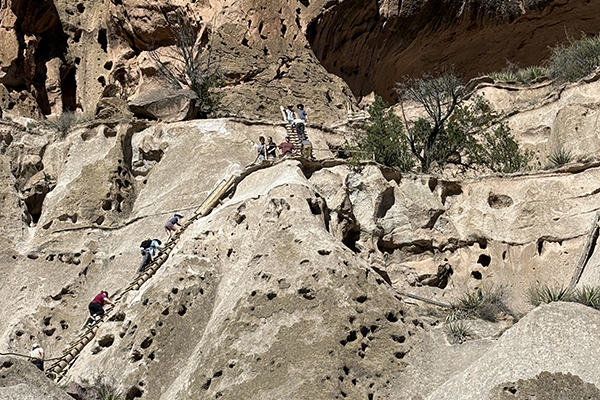
“At some points, visitors are waiting for others to finish exploring a cultural resource before they can enter themselves,” D’Antonio said. “You might be walking along a wide paved trail and around the corner encounter a line of people waiting to climb a ladder into a cavate. It's a very different visitor experience than what you see in many other parks.”
In 2025, Bandelier recorded 247,642 recreation visits. While that number is modest compared with some national parks, it represents substantial use at a monument with sensitive cultural resources.
Because many of Bandelier’s cultural resources are fragile, the park has limited options for expanding trails, parking areas or roads to accommodate increasing visitation. As a result, managers are exploring ways to better distribute visitors, reduce crowding and limit impacts on the landscape.
“The goal is to understand how visitors use the transportation and trail system that already exists,” D’Antonio said. “We're interested in understanding what causes queues at cultural resources and how to minimize those so visitors can spend their time learning about and connecting with these places rather than waiting to access them.”
One focus of the study is transportation. During peak visitation periods, the monument’s parking lot often reaches capacity, creating challenges for managing visitor flow throughout the site.
“The park has tried using a shuttle bus system during the busiest times of the year. However, shuttle systems can cause ‘pulses’ of visitors in the trail systems when the bus unloads, which increases the risk of queues at destination sites and potential damage to cultural resources,” D’Antonio said.
The research team is using vehicle counters, trail counters, GPS-based tracking and direct observations to understand how visitor movement changes during busy times of the year such as Spring Break when the shuttle is running and slower periods when there is more likely to be ample parking for visitors.
“Understanding the relationship between the transportation system and visitor use of the trail is a first step in identifying potential management actions that don't rely on infrastructure changes,” D’Antonio said.
For Kostelnick, the project provides an opportunity to apply classroom concepts in a real-world setting while contributing to a management challenge facing public lands across the country.
“One of my favorite parts of field work is the ability to bridge the conceptual side of what I’m learning in class to the tangible by engaging with actual field research in dynamic settings,” she said. “As a graduate student, this allows me to engage with my field beyond traditional coursework and apply my degree in a way that supports my professional goals for my future career.”
The project also provides research opportunities for undergraduate students. Henry Dryden and Nick McClaskey, graduating seniors in the College of Forestry’s tourism, recreation and adventure leadership program, are assisting with data collection.
“Involving undergraduates in projects like this one is really important for providing early exposure to research methods and best practices, as well as mentorship from faculty members,” Kostelnick said. “It allows students to see themselves as contributors to their field, which can help them find a sense of belonging as future scholars.”