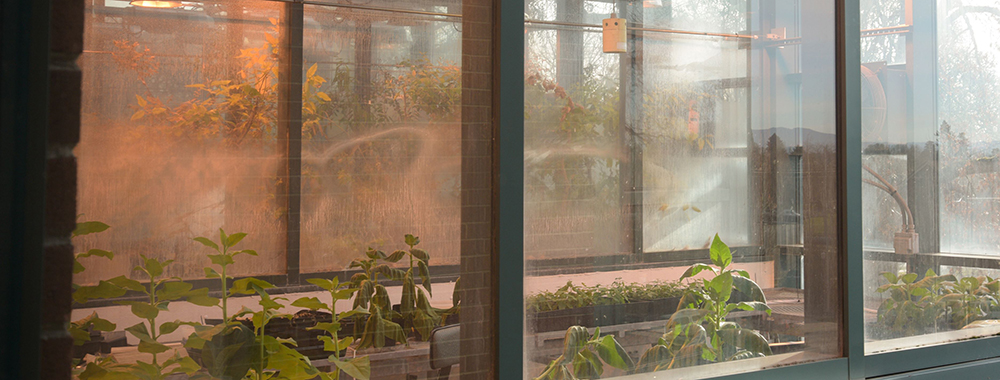
To strengthen research on invasive pests threatening Oregon’s forests, the College of Forestry is restoring its insect pest quarantine research facility after several years out of service. Led by Professor John Riggins, a forest health and entomology specialist who joined the college in 2025, the renovated lab marks a new chapter for one of Richardson Hall’s specialized research spaces.
The college built the original quarantine lab in 1999 as part of Richardson Hall’s construction to support its role as the state’s legislatively designated Forest Research Lab. For many years, the lab — which included a rooftop greenhouse — provided a safe, controlled environment for studying invasive species and pathogens, including non-native forest insects and fungi, without risking their spread.
The facility operates under a rigorous set of safety standards established by the Centers for Disease Control and Prevention, including specialized ventilation and decontamination systems. A key component of these standards is a pass-through autoclave, an essential device that allows researchers to transfer materials in and out of the lab without risking contamination. The autoclave uses interlocking doors to create a secure barrier: researchers load contaminated materials from the “dirty” side of the lab, sterilize them with high-pressure steam, and remove them from the clean side, maintaining strict containment throughout the process.
When the autoclave broke down a few years ago, the lab no longer met quarantine requirements, prompting the college to take the facility offline. As pest and disease threats such as emerald ash borer and ambrosia beetles continue to increase, however, the college turned its attention back to the lab, committing resources to refurbish the space.
Riggins brings extensive experience and a true passion to the project. Before joining Oregon State, he spent 17 years as a professor of forest entomology at Mississippi State University, where he focused on forest insects and fungi.
“When I came for my interview and again on my second visit, I was shown the facility and it wasn’t being utilized,” Riggins said. “This college makes efficient use of nearly every square inch of space, so it really stood out as a good opportunity to redevelop this as a resource — not just for the College of Forestry, but for OSU and the state of Oregon. Having a facility like this allows us to study non-native forest insects and pathogens safely and responsibly.”
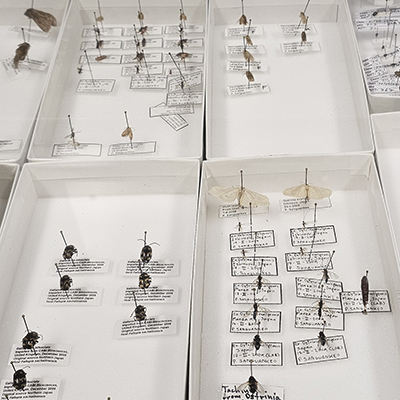
The restored facility will help protect Oregon’s forests from emerging threats by enabling advanced research on invasive species. This work supports local ecosystems, helps safeguard industries that depend on healthy forests, and strengthens the university’s research capacity statewide.
To complete the renovation, the college leveraged Richardson Hall’s mechanical systems renewal project to address building infrastructure needs that would have been prohibitively expensive to tackle independently. Additional college funding supported the autoclave replacement, decontamination system re-commissioning, space reconfiguration, and quarantine certification. Researchers must also develop updated quarantine protocols to guide lab entry and exit procedures, as well as the handling of materials during research projects.
Riggins is optimistic about the quarantine laboratory’s future.
“I’m hopeful the lab can become a resource for others doing similar work, whether within the College of Forestry, researchers throughout OSU, or partner agencies around the state,” he said. “My goal is for it to be a functional, well-equipped space where we can safely and responsibly study forest pests and begin answering important questions about non-native species threatening Oregon’s forests.”