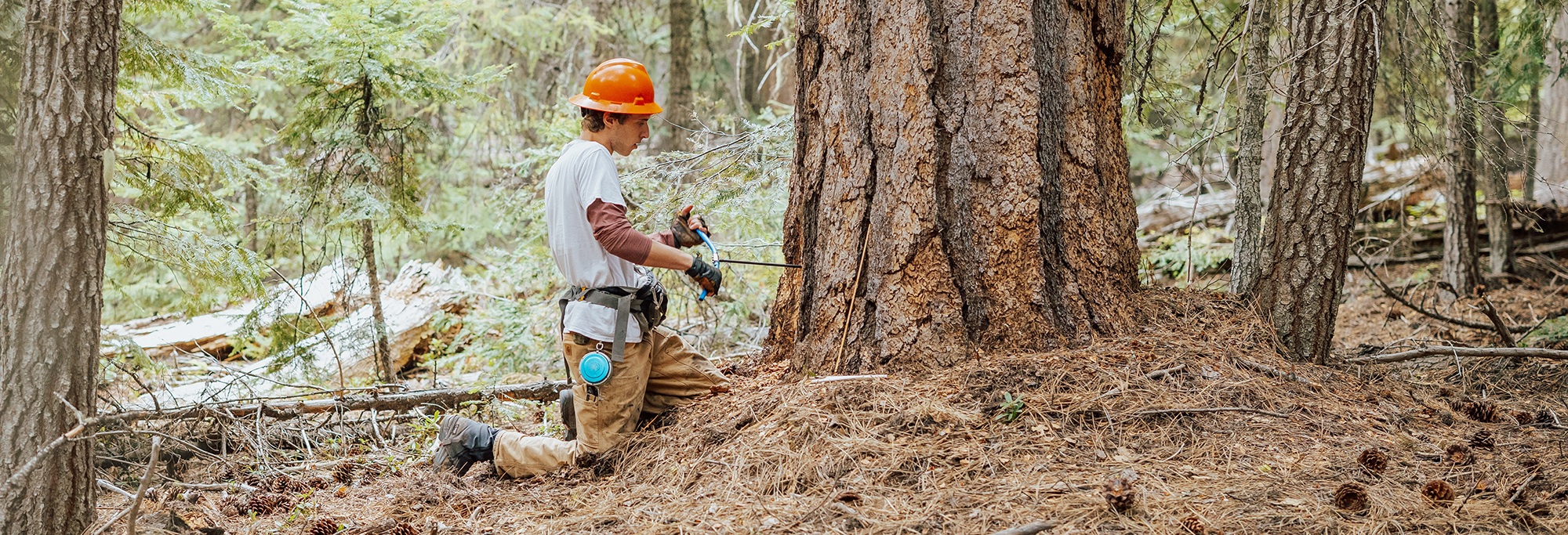
In a quiet corner of the OSU College of Forestry, a growing team of researchers is using the past to inform the future. The Tree Ring Lab, one of the college’s fastest-growing research spaces, studies forest disturbance, climate and succession — using the annual records stored in trees themselves.
“When the lab first started, there was just one measuring station,” said Andrew Merschel, lead scientist and lab co-director. “Now we have a full shop, dedicated lab spaces and a team of about 13 staff and students.”
Researchers have built multi-century tree ring histories across Oregon and Washington that help partners such as collaborative groups, Indigenous tribes and state and federal agencies better understand how fire, people and climate have shaped today’s forests.
Tree ring analysis, once rare in the Pacific Northwest, is now offering new insights into the region’s ecological and cultural history. Every ring tells a story and reveals past fire events, droughts and shifts in forest dynamics.
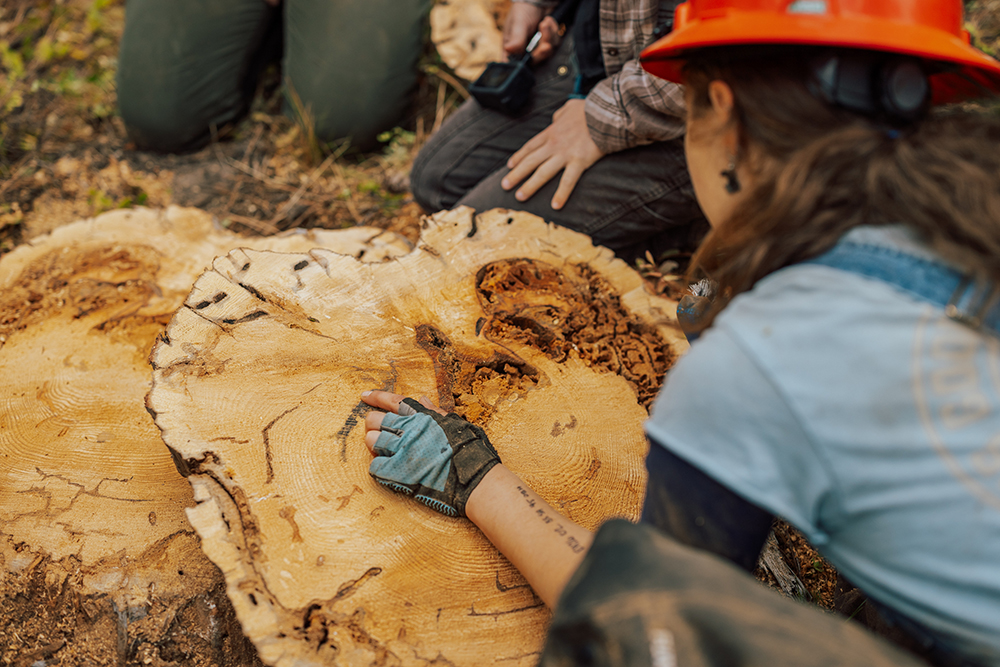
During a recent field day, the lab team and collaborators explored those stories firsthand. The group first examined fire scars on old stumps, revealing as many as six distinct fire events over the last few centuries. They then collected core samples from living trees, a process that leaves only a small, harmless mark but provides decades of growth data.
Among the lab’s researchers is graduate student Maddie Washburn, whose work bridges science and communication. Maddie first joined the Tree Ring Lab in 2022 while working in the Elliott State Forest and has worked with the team ever since.
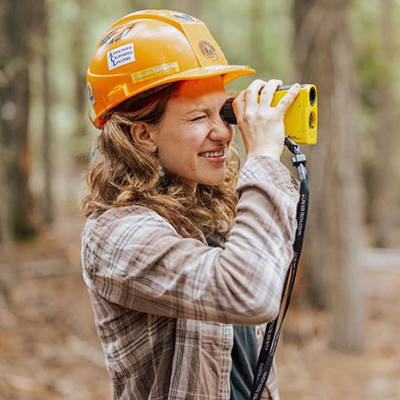
Her graduate program project, “Engage Mt. Hood: Science Communication and Community Collaboration,” aims to make complex research accessible to the partners and communities it serves. Working alongside the Mt. Hood National Forest, OSU Extension Fire Program, Hood River and Wasco County Forest Collaboratives, and the Confederated Tribes of Grand Ronde and Warm Springs, she is developing digital tools to share findings on fire history and forest conditions.
“I chose this science communication project because I believe rebuilding trust between the public and forest management is essential for the future of forestry,” Maddie said. “Working in the Tree Ring Lab showed me how valuable historical fire data can be for guiding management, so it felt like a perfect fit to engage in a project that would allow me to explore the best ways to share this information.”
Her final materials will include a longer-form video, an interactive online story map open to the public and short videos and slideshows for social media and meetings. These resources are designed to support collaboration and informed decision-making.
As the Tree Ring Lab continues to expand its work and partnerships, its mission remains rooted in connection — linking science and storytelling to help guide the future of Pacific Northwest forests.
“A quote that drives my work is Anna Roe’s quote, ‘Nothing in science has any value to society if it is not communicated,’” Maddie shared. “My goal is to help practitioners make informed decisions and to connect people with fire ecology and science in ways that are accessible and meaningful, because better management decisions grounded in sound science can help rebuild trust between communities and forestry professionals.”