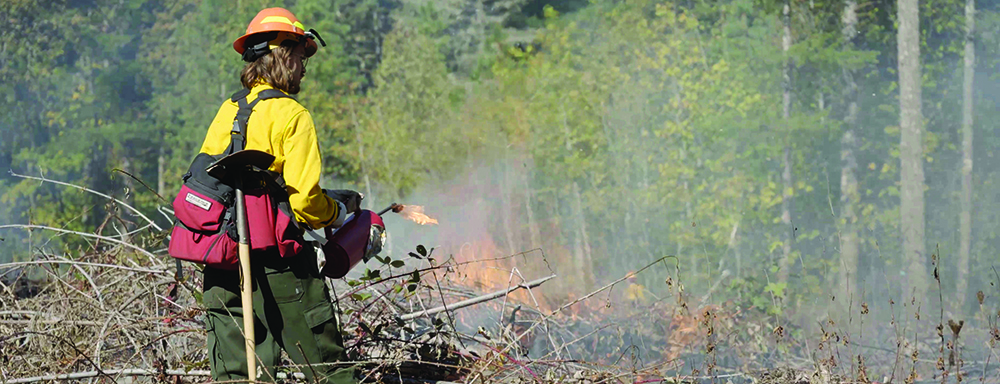
Last October, during the mid-morning hours in the McDonald-Dunn Research Forest, low flames moved deliberately across the forest floor as students from the College of Forestry carried out a prescribed burn just minutes from OSU’s Corvallis campus. Surrounded by nearby homes and communities, the burn required not only ecological analysis, but multi-stakeholder planning and clear communication.
Leading the effort was Associate Professor John Punches, an OSU Extension educator with more than 30 years of experience. His fire practicum is an elective course that attracts upper level undergraduate and graduate students who choose to be there, drawn by a desire to understand fire not just as a concept or theory, but as a practical tool.
“I want students to have opportunities to actually engage with fire. Not just learn about it, but do it,” Punches said.
Punches emphasized the need for hands-on learning and professional advancement opportunities for burn practitioners as well as the value of giving the public firsthand experience with prescribed fire.
“Media often teaches us that fire is scary, but with prescribed fire it’s common to see flames only about a foot high,” Punches said. “You can literally stand in the fire and talk to students. Most of the time, fire is fascinating — not frightening.”
The burn took place within two small units of the recently completed Woodpecker Harvest on the McDonald-Dunn Research Forest. Mark Swanson, interim director of the OSU Research Forests, identified the sites for their ecological restoration potential. One unit focused on releasing Oregon white oak and Pacific madrone, while another targeted a stand of fire-adapted Willamette Valley ponderosa pine.
Historically, much of the Willamette Valley supported oak woodlands and ponderosa pine, maintained by frequent, low-intensity fire purposefully and intentionally set by Indigenous peoples. Decades without fire have allowed dense understory growth and Douglas-fir domination to take hold in the McDonald-Dunn Research Forest and throughout the Willamette Valley. Carefully planned prescribed fire can help reverse those trends, improving wildlife habitat, reducing fuel loads and creating a more diverse, open and resilient forest structure.
Students spent the term developing multiple burn plans, learning how to assess fuels, manage fire intensity, and design contingency and emergency response plans. Final approval from the Oregon Department of Forestry came the afternoon before ignition, underscoring how narrow burn windows can be — especially in smoke-sensitive areas like the Willamette Valley.
Because the forest is surrounded by residential neighborhoods, communication was as critical as ignition. College of Forestry staff conducted extensive outreach, including mailings, electronic newsletters and door-to-door conversations with nearby residents.
“We did our best to be very diligent about notification because trust is so important. We informed neighbors of the process, safety procedures, why we burn and when, and offered a copy of the burn plan,” said Punches. “We even invited neighbors to watch.”
The final burn was designed to produce just enough heat to reduce shrubs, weeds and small trees without damaging overstory species. The goal was to have a “Goldilocks fire” — carefully managed to improve wildlife habitat and increase forest diversity. While satisfied with the ultimate results, particularly in the oak habitat, Punches characterized the results as “dirty burns.”
“When you return fire to areas that haven’t experienced fire for a while, or under damp conditions, the results can be patchy and scattered because of wet fuels and hard-to-ignite larger fuels,” Punches said. “Just like a fireplace, prescribed burns need ample fine, dry fuels to get larger fuels going.”
For students, the burn provided lessons difficult to replicate in the classroom — from writing actionable burn plans and working as a coordinated fire team to navigating state and local approvals and communicating with neighbors about the ecological benefits of prescribed fire.
The burn also serves as a strong example of how active management supports the research, teaching and outreach mission of the forest. The Woodpecker Harvest produced marketable timber while providing students with hands-on experience in harvest planning and execution. The treatment benefited the stands by releasing trees for continued health and resilience, and it created the conditions necessary to restore historical ecological communities, such as oak and madrone, which are now sparse across the forest. In addition, the prescribed burn expanded opportunities for education and future research by demonstrating how the reintroduction of fire can support landscape restoration, particularly in south-facing Douglas-fir stands that are increasingly vulnerable to drought and heat stress under a changing climate.
“We have to change how we think about fire, and it starts with understanding that our region is shaped by it,” Punches said. “Instead of imagining Smokey Bear preventing all fire, I like to think that after a prescribed burn, he would happily point out the roasted acorns, new regeneration and productive huckleberry patches.”
And on a fall morning last October in the McDonald-Dunn Research Forest, College of Forestry students put that perspective into practice — restoring a process long tied to land stewardship in the Willamette Valley and gaining experience that will shape how they manage forests in the decades ahead.