The College of Forestry humbly recognizes and honors our past, present and future students, employees and their families who have served or continue to serve in the United States military. Over the last decade, ten percent of our students have represented the military community — embodying dedication, courage and service. This memorial, crafted from different species of woods, symbolizes the strength and unity of all branches of service and the deep-rooted values we share as part of the Oregon State family.
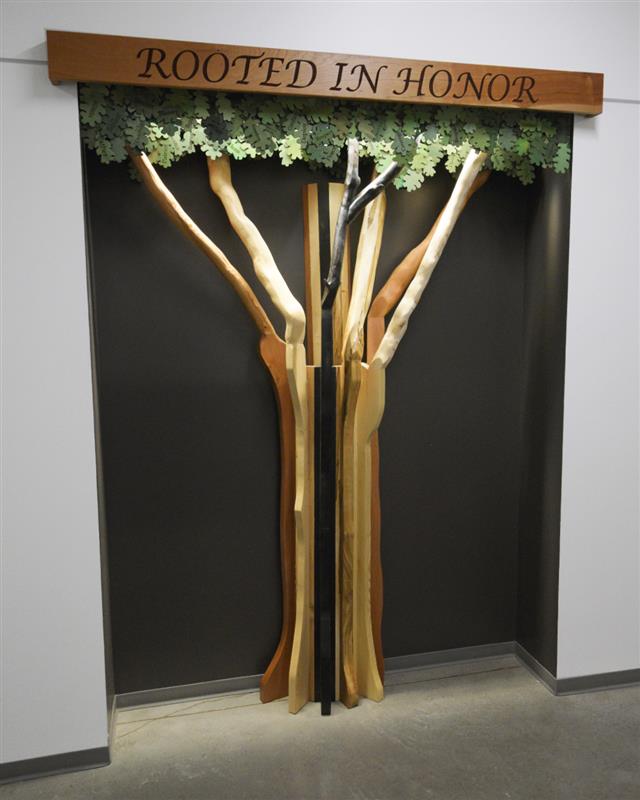
“Rooted in Honor”
By Arthur Myers
This sculpture is a memorial to the courage, sacrifice and unity of the United States Armed Forces and its veterans. Designed in the form of a tree and composed of six distinct wood species, each element pays tribute to a branch of service.
As a Navy veteran, this work is deeply personal. It reflects not only my own journey in uniform but the shared legacy of all who have served. Every cut, join and inlay was made with reverence — for the lives lived in service and for the stories that continue to grow.
Douglas fir represents the Army, sourced from reclaimed lumber salvaged from a historic Oregon structure. Its reuse speaks to resilience and the enduring strength of those who serve. Douglas fir was a staple in barracks, bridges, warehouses and docks due to its high load-bearing capacity, resistance to warping and availability in large dimensions.
Ash honors the Air Force, chosen for its flexibility and strength — qualities essential to flight and innovation. Early aviation pioneers, including the Wright brothers, used white ash for parts of their aircraft that needed to be bent, such as wing ribs. Ash was chosen because it is strong, flexible and shock-resistant.
White oak signifies the Navy, harvested from a fallen tree along Oak Creek on the Oregon State University campus. In November 2023, this mighty oak came down in the early morning, crushing a work van. The U.S. Navy maintains a forest of white oak trees in Indiana specifically to preserve and repair the USS Constitution, the oldest commissioned warship still afloat. In the early days of the U.S. Navy, white oak was the backbone of warship construction, including the USS Constitution, nicknamed “Old Ironsides.” White oak wood is prized for its strength, durability and resistance to rot, making it ideal for shipbuilding.
Southern yellow pine stands for the Marine Corps — tough and tenacious, rooted deeply in tradition and grit. Southern yellow pine became a go-to material for military installations due to its load-bearing capacity and adaptability to pressure treatments. It’s commonly used in piers, docks, bulkheads, boardwalks and light vehicular bridges on Marine Corps bases.
Mahogany reflects the Coast Guard, prized for its beauty and strength, symbolizing vigilance and protection along our shores. Mahogany is resistant to rot and machines easily, making it ideal for boat-building. It has been used in the construction of decks, hulls, rails and interior trim.
Apollo 14 Moon Tree — a Moon Tree is grown from seeds that have orbited the moon. The tradition began with Apollo 14 in 1971, when astronaut Stuart Roosa carried tree seeds into lunar orbit. It represents the Space Force, a nod to exploration, vision and the boundless frontier. The wood used in this sculpture was respectfully gathered from dead limbs of the living Moon Tree that still stands outside the Peavy Forest Science Center on the OSU campus.
Embedded within each species is a challenge coin specific to its corresponding branch. These coins, traditionally exchanged as tokens of respect and camaraderie, serve as a tangible link to the individuals who have served.
The tree’s roots anchor it to the earth, symbolizing the deep commitment of our veterans to their country. Its trunk rises with strength, and its branches reach outward, representing the legacy of service that continues to inspire future generations.