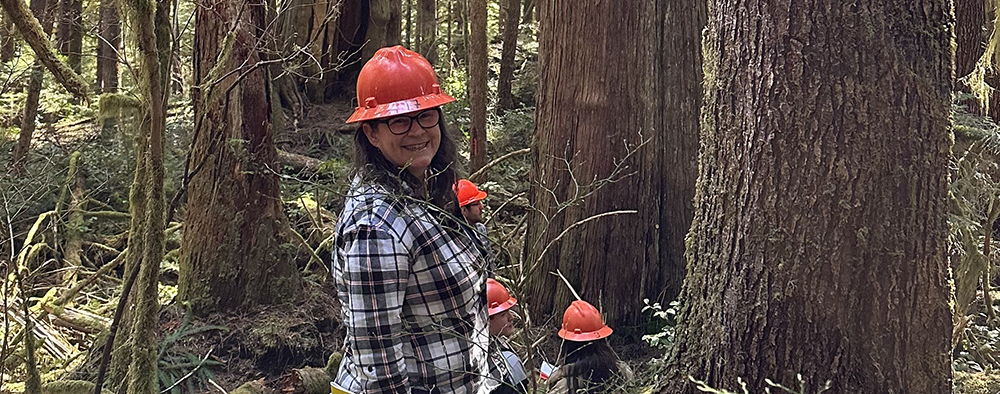
Mindy Crandall, a forest policy associate professor and interim head of the Forest Engineering, Resources and Management Department, has experienced the McDonald-Dunn Research Forest from multiple perspectives during her time at Oregon State University. From undergraduate labs and summer jobs to faculty research and weekend recreation, the forest has shaped every stage of her experience. Her story highlights the lasting impact of the research forest and its strong connection to the Corvallis community that calls its trails home.
Crandall arrived at OSU as an undergraduate in the 1990s with a 6-month-old baby, unsure of what to expect. Growing up in rural coastal Oregon, she hadn’t imagined attending a large university. At the College of Forestry, she quickly found her place.
“I felt at home here because, if I had been in another major with nothing but 200-person classes and didn't get to know my professors, I don't think I would have finished my degree,” Crandall said. “But with forestry, it was so great to be in a small college. People knew you by name and were so friendly and supportive. It really helped me feel like I was still part of a community.”
That sense of belonging extended into the forest, where her lived experience connected with her formal education.
“I got to learn things about trees in the McDonald-Dunn that I already understood from growing up and spending time in the woods,” she said. “Before my undergraduate studies, I didn’t know the names of trees, but I knew immediately when someone talked about a Sitka spruce that it hurts to touch. Learning more about the technical side of the forest built on the knowledge and experience I already had.”
Her first hands-on work came during a summer job with the Continuous Forest Inventory (CFI) crew, where she learned to measure plots and navigate the realities of fieldwork.
“Some of my favorite memories were hacking sections out of 3" thick poison oak vines, to get accurate diameter measurements, and quickly realizing that keeping your D tape at 4.5 feet above ground gets really complicated on steep slopes,” she said. “I still remember going straight to pick up my son from day care and trying to keep him away from touching the bottom of my work pants which were no doubt covered in urushiol.”
Over time, her perspective expanded from individual trees to the forest as a whole — a shift reflected in her role on the faculty advising committee for the McDonald-Dunn Forest management plan.
“As an undergrad, I was focused on individual trees,” she said. “Later, as a recreationist, I covered miles of trails on a bike. And now, as a member of the planning committee, I’m thinking about the entire forest.”
These shifting perspectives, she said, have deepened her appreciation for the forest and its role in both education and community life. She also emphasized the importance of the research forest’s proximity to campus as a consistent, hands-on resource for students.
“I think it is an incalculable value that our students can be in the woods every week, and that opportunity exists because it is 20 minutes from campus and so accessible,” she said.
“That close proximity turns theory into practice. You're not just learning abstract things, and then maybe once a month, seeing them in person,” she said. “Hands-on learning is essential in forestry and being able to go multiple times a week makes all the difference.”
For Crandall, the forest is more than a teaching tool — it’s a shared space.
“We have a resource, literally in our backyard, that brings something to everyone in the community,” she said. “That's why people love it so much and care about what happens to it.”