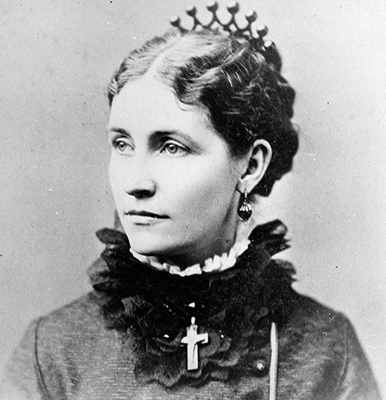
Long before her name became part of Oregon State University’s landscape, Mary McDonald stood in a California pasture choked with tumbleweed.
In the early 1920s, land on the McDonald estate in California was showing signs of damage from Russian thistle, an invasive species threatening surrounding properties. The California Department of Agriculture hired George W. Peavy, then dean of forestry at Oregon Agricultural College (later Oregon State University), to assess the problem. Peavy determined that years of overgrazing had weakened native vegetation and recommended management changes that allowed the land to recover. The approach worked.
Grateful for Peavy’s expertise and interested in his practical, science-based approach to land stewardship, Mary McDonald made her first gift to Oregon Agricultural College in 1926. That gift marked the beginning of a lasting relationship rooted in a belief in the power of education.
Born Mary Julia Ledlie in 1848, McDonald came west as a teenager, eventually becoming a successful businesswoman overseeing agricultural, mining and timber interests in California and Oregon after the death of her husband, Captain James Monroe McDonald. She was deeply engaged in the intellectual life of her time and known for supporting universities, libraries and public institutions that advanced both science and the arts.
At Oregon Agricultural College, Dean Peavy and professor and alumnus T.J. Starker were working to establish an actively managed research and demonstration forest where students could learn in the field and research could inform forest practices across the Pacific Northwest.
Starker identified and negotiated land purchases, while Peavy coordinated donations and guided the vision. McDonald became a key benefactor in this effort.
Beginning in the mid-1920s, McDonald donated land in southern Oregon, which the college sold to help finance forest acquisitions near Corvallis, and provided direct financial support and scholarships for forestry students. By the time of her death in 1935, roughly 3,000 acres had been acquired for what would become the McDonald Forest. In her will, she left all her Oregon property to Oregon Agricultural College.
McDonald’s commitment to education extended beyond forests. In the early 1930s, she donated rare and finely bound books to the college, eventually funding the construction of the McDonald Rare Book Room, which opened in 1934.
Nearly a century later, Mary McDonald’s legacy lives on in the McDonald Forest, now managed in conjunction with the Dunn Forest as the McDonald-Dunn Research Forest. It endures as a collaborative space shaped by students, faculty and a commitment to stewardship that spans generations.