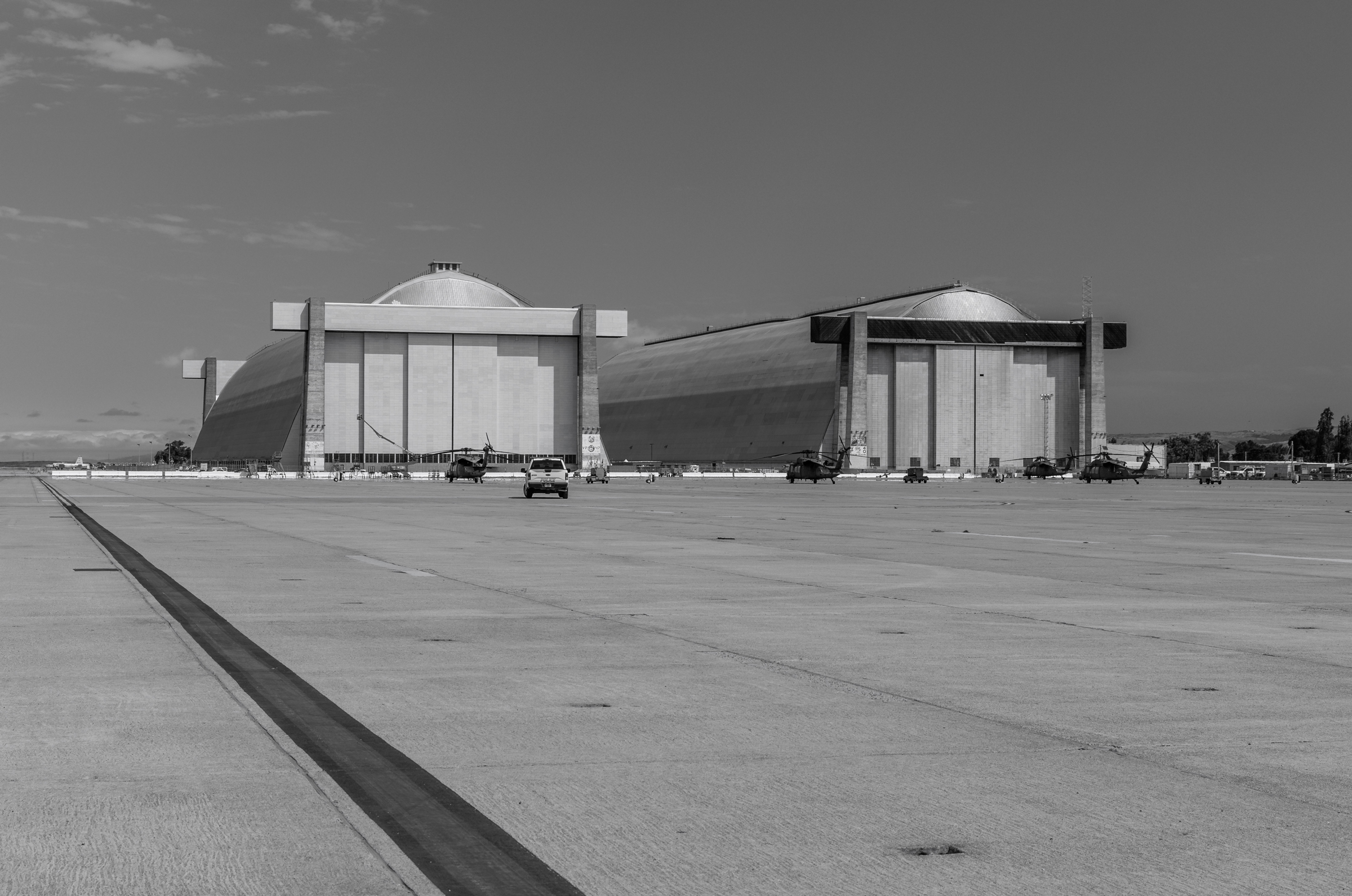
Photo Credit: South facades of Hangar 2 and Hangar 3, Naval Air Station Moffett Field, Stephen D. Schafer, 2022. Courtesy Library of Congress, Prints & Photographs Division, HAER, CA-335-B-43
More than 80 years after massive Douglas-fir timbers were raised to build a World War II airship hangar in California, some of that wood is beginning a second life — with help from Oregon State University researchers.
Faculty and researchers in OSU’s College of Forestry helped determine whether lumber salvaged from Hangar 3 at Moffett Federal Airfield could be safely reused in modern construction, contributing to a yearslong effort led by Google to keep valuable structural wood in use rather than send it to a landfill.
Built by the U.S. Navy in 1943 in Mountain View, California, Hangar 3 stretched more than 1,000 feet and was constructed largely from old-growth Douglas-fir harvested from forests near Mount Hood. Google subsidiary Planetary Ventures assumed management of the hangar in 2014 as part of a long-term lease of the federally owned Moffett Federal Airfield from NASA. By then, decades of use had taken a toll on the massive timber structure, which eventually deteriorated to the point that it could no longer be safely maintained.
Plans to deconstruct the hangar raised another question: Could its structural lumber be recovered and used in new buildings?
Answering that question required determining whether the 80-year-old wood could meet modern structural requirements. Scott Leavengood, director of the Oregon Wood Innovation Center and a professor in the Department of Wood Science and Engineering, led Oregon State’s involvement in the research. Tyler DeBoodt, a 2026 recipient of OSU’s Outstanding Faculty Research Assistant Award, also contributed to the project, along with graduate students Hillary Johnson and Ji-Wei Chen and undergraduate student Kim Vega.
“I’ve tested a lot of different wood products, but this project was unlike any of them,” Leavengood said. “The wood was beautiful — tight-grained, largely free of knots and darkened by decades of heat. You could even see what appeared to be marks from the hand tools craftsmen used to cut the complex angles for the hangar.”
Strength wasn’t the only concern. The lumber had been exposed to chemicals, including fire-retardant treatments, during the hangar’s long history. Before the wood could be reused, the team had to determine which material could be safely recovered and how it should be processed.
Building codes presented another challenge. Because lumber-grading systems are largely designed for new wood products, there are few established methods for qualifying reclaimed lumber for structural use.
At OSU’s Wood Science and Engineering Laboratory, researchers tested more than 200 pieces of lumber to characterize the strength and stiffness of the salvaged Douglas-fir. Zip-O-Laminators, an Oregon-based manufacturer of engineered wood products, also produced several glulam beams from the reclaimed material for testing at no cost to the project.
The results helped the project team determine which lumber was suitable for remanufacturing into structural products. Ari Sinha, professor and JELD-WEN Chair of Wood-based Composites Science, reviewed the calculations and converted the test results into design values — the key numbers engineers use to determine how structural wood products can be used in buildings.
The testing and recovery effort showed that a substantial amount of the hangar’s wood could be put back to use. According to Google, about 119,000 board feet — approximately 178 tons — of Douglas-fir was salvaged. After potentially contaminated outer layers were removed and the remaining material evaluated, about 66,000 board feet met requirements for mass timber remanufacturing, enough lumber to frame roughly four average single-family homes.
Giving the lumber a second structural life offers benefits beyond keeping valuable material out of a landfill. Reuse extends the time carbon remains stored in the wood and reduces the need for new materials, demonstrating how buildings can serve as sources of materials for future construction.
Some of the reclaimed lumber is being used in Google projects, including a mass timber office prototype in The Dalles, Oregon. Other pieces have been incorporated into architectural applications on Google campuses. For the lumber headed to The Dalles, the reuse brings the material close to where its story began: Old-growth Douglas-fir harvested from forests near Mount Hood more than eight decades ago is returning to the region as part of a new generation of timber construction.
Google documented the Hangar 3 effort in its 2026 white paper, “Reclaiming Structural Wood at Scale: From Airship Hangar to Portfolio Reuse.” The report examines lessons from the project and how salvaging and reusing wood from existing buildings could support a more circular approach to construction.
The Douglas-fir from Hangar 3 had already supported one of the nation’s enormous wartime airship structures for more than eight decades. Oregon State University research helped show that, for some of that wood, its first 80 years of service did not have to be its last.