When Jorge Rios ’07 graduated with a degree in Recreation Resources and Management — known today as Tourism, Recreation and Adventure Leadership (TRAL) — he expected to follow a straightforward path into recreation management or the park service. Instead, his journey took a series of unexpected turns that ultimately revealed how well his College of Forestry education had prepared him to shape forests and communities.
The first turn came when he was offered two jobs after graduation, both with the Oregon Department of Forestry (ODF): one in the Recreation Program, perfectly aligned with the future he had pictured, and one in a planning role far outside what he imagined for himself. Trusting his curiosity, Rios chose the forestry position and joined the state, first as a field forester and eventually became a planning coordinator."
“I could have taken the recreation job and gone into the field I originally thought I would, but something in me wanted to try the forest management path instead. I took that job—and here I am, 17 years later,” Rios said.
Choosing the forestry path opened the door to a role that blended technical planning with the kind of people-centered coordination his College of Forestry education emphasized.
Rios explains that his work involves a mix of GIS analysis — tracking timber sales and managing spatial and tabular data — and developing annual operations plans for each district across the state. As a planning coordinator, he brings together specialists from multiple disciplines to ensure projects move forward smoothly.
“I’m coordinating with a variety of resource specialists, like biologists, geotechnical specialists, engineers,” he said. “A district may be looking at a certain project, and it’s up to me to pull everyone together and ask, ‘Are there any issues? What do we need to do beforehand? What should we be planning for?’”
Although the work is rooted in forestry, the skills he uses every day — communication, collaboration, consensus building and community focused decision-making — mirror the core strengths of the recreation resources and management/ TRAL program. Students in the major learn to work with diverse stakeholders, navigate conflict and support the sustainable use of natural resources — all essential elements of Rios’s work.
“I absolutely think that aspects of my major have served me well and have played directly into my career,” Rios said. “As a planner, I need to coordinate with professionals from various disciplines to gather and share information. Having a foundation in natural resources is crucial to understanding the data and concepts I work with daily. OSU’s focus on interdisciplinary collaboration has proven incredibly beneficial.”
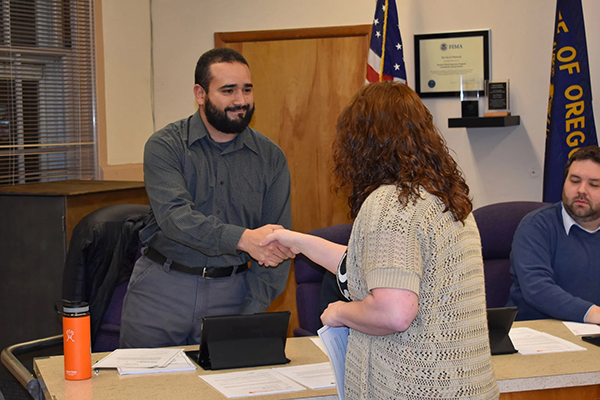
That emphasis on collaboration and community minded planning didn’t stay confined to his work at ODF. Around the same time, Rios stepped into another leadership role — serving as a Tillamook city councilor after running unopposed for an open seat.
“It was a great experience, and I'm grateful to have been able to work with and for my local community,” Rios said. During his term, he gained valuable experience in budget planning, public process and working with diverse viewpoints.
“One of the areas I was glad to be part of was revitalizing the downtown area,” he explained. “Tillamook is a small town, and industries have changed over time, causing economic challenges. So bringing businesses back and creating a more welcoming environment for residents was a main focus. We designated a Town Plaza for public events, attracted new businesses and worked with the Chamber of Commerce to add wayfinding signs.”
In hindsight, the “unexpected” turns in Jorge’s path were exactly what allowed him to find purpose in both his work and his community. His experience illustrates that students don’t need to have every step mapped out — the skills and values developed at OSU and the College of Forestry can guide them toward opportunities that match their strengths, curiosity and desire to serve.