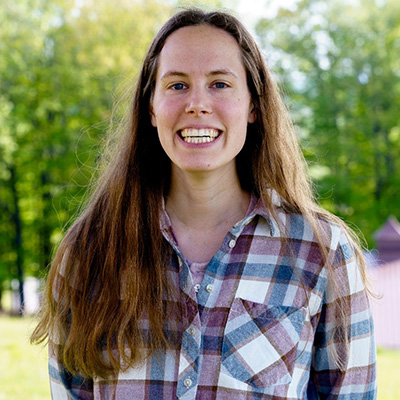
Graduate student Lynn Riley is no stranger to tackling complex climate challenges. As a lead author of a recent Nature Communications study, Riley helped reveal how forest-based carbon credit projects can have both cooling and warming effects depending on changes to the Earth’s reflectivity, or albedo. Now, she’s continuing to explore how science can improve the integrity and transparency of global carbon markets. In this edition of 6 Questions, we caught up with Lynn to learn more about her research journey, what inspired her to pursue forest carbon science and how she hopes her work will shape climate solutions in the years ahead.
What inspired you to study carbon crediting and forest-based climate solutions?
My inspiration first came when I started working at the American Forest Foundation (AFF) in 2019. AFF has for decades engaged small family landowners (who own a plurality of US forest land) in conservation, but funding that work at a large enough scale to make a meaningful contribution to global climate mitigation goals was impossible with philanthropic funding alone. Carbon markets provide a way for us to empower this huge segment of people to achieve their goals and meaningfully contribute to a livable climate. And, I think carbon crediting and markets make a lot of sense: land management that harms the climate or isn’t optimally utilized could be considered a market failure, and I believe market solutions that instead incentivize long-term, sustainable management and restoration are a critical and effective tool among others in addressing externalities. Of course, the science has to be sound for us to make market mechanisms work, which led to my desire to study this further so I could help implement something meaningful at scale with AFF and help others implementing reforestation broadly.
In terms of other pieces of science, Griscom et al, 2017 and Fargione et al, 2018 were foundational for me, pointing to the hope and potential of Natural Climate Solutions. In addition, through working at AFF, I have been lucky to talk with many family landowners and hear their stories, which continues to inspire me as I learn about what they think about when they steward their land. And I think of what I hope the world can look like for my own family and three sons who range from 4 months to 5 years old. Studying and tightening the science of Natural Climate Solutions and implementing them on the ground with AFF feels like the best role I can play right now in the bigger climate effort.
How did the collaborative project come together, and what was your role in helping to lead it?
I had a lot of support from the beginning with this project. The idea behind the paper began as my term paper for MNR 550: Climate Change Impacts on Forests with Dr. Chris Still in fall 2023. Dr. Still encouraged me after I submitted that term paper that it might have the potential to be published, and he connected me with other professors at OSU who he thought might be interested in collaborating, Dr. Jacob Bukoski (now my graduate advisor) and Dr. Loren Albert. I reached out to them and was lucky they agreed to join the project. This is the first time I have pursued a peer-reviewed publication, and they were all incredibly supportive with what I am sure were many beginner questions I asked along the way about how the publication process works.
Dr. Bukoski then connected us with Dr. Susan Cook-Patton with The Nature Conservancy, who is one of the world’s leading reforestation scientists, and she agreed to collaborate. She brought in Dr. Chris Williams with Clark University, one of the world’s leading albedo experts. I am so grateful that this group assembled together, and everyone brought essential pieces of expertise and insight into the final paper.
In terms of roles, I led the writing and worked together with Dr. Bukoski on the data and analysis portions. All of the collaborators advised along the way and contributed to drafts, particularly related to their areas of expertise.
For those who might not be familiar — what exactly is albedo, and why does it matter for climate change?
Think of a time you were outside in the sun in a light colored shirt. Then think of a time you were outside in the sun in a darker colored shirt. Which one felt warmer?
The effect that makes darker colors of clothing feel warmer is the same effect that makes different land surfaces contribute to warming differently: albedo. It’s a measure of the incoming shortwave radiation from the sun that is reflected to space relative to what is absorbed by the surface and converted to heat in the Earth system. Smaller albedo means that less radiation is reflected back to space, more is retained, and thus more heat is added to the Earth system. Different colors of land surface are more or less reflective of this radiation. When lots of land surface changes from light to dark around the world, it can make an impact on warming, or vice versa. Even something like painting the roofs of buildings a lighter color can make a difference and help climate cooling. Some forest types are darker relative to other land surfaces like grasses or snow, and so different types of forestation or forest management at scale can influence albedo.
What surprised you most about your findings?
I was pleasantly surprised to see how many reforestation projects could be having positive—climate cooling—albedo effects, which was the case in 9% of the projects we analyzed. I am hopeful that this can be further explored, measured, and validated so we can prioritize and fund activities and communities in these areas—such as reforestation in tropical biomes--that are delivering even more climate mitigation than the market currently accounts for.
What do you see as the next big question or challenge for scientists studying forest-based climate solutions?
There has been so much progress scientifically for forest-based climate solutions, and there is always more that can be improved. Our look into albedo was one small step toward hopefully integrating more biophysical processes into carbon markets, which historically have limited their focus on biochemical (i.e., GHGs) processes in what they measure and account for.
I would also love to see more science around how to reduce or manage the uncertainty associated with forest-based climate solutions. If we want to implement projects at scale, we need them to be investable, and investors usually require a certain level of certainty to make investments. They want to know how much climate mitigation a project will produce, how valuable it is, and when it can be delivered. Of course, forests are dynamic and embedded within complex socioeconomic systems; there will always be a level of uncertainty. But can we get a little less uncertain, and a little better at predicting outcomes? And what sorts of solutions can help us manage the uncertainty that remains, in a way that equitably shares risk across the market? These questions that bridge science, economics, and policy are really interesting to me and I think are next key things to funding Natural Climate Solutions to their full potential among other climate mitigation tools. Scientists who help us answer these questions will unlock real implementation at scale.
As a graduate student leading a study with global implications, what advice would you give to other students starting their graduate studies?
My advice would be to find research or implementation gaps that really interest you and you believe will make a difference, and collaborators you enjoy spending time with, and the long journey of publishing a study will be a joy (at least, 95% of the time). I was daunted when I first thought about undertaking this project and several times along the way, but really encouraged by my collaborators, and I’m so glad I gave it a try.
Secondly, I would advise leaning your science toward solutions. Of course we need science to identify issues, but doing so without naming implementable and viable solutions tends to lead to arguing rather than progress toward the climate goals we all care about. I think the best way to do that is to get as close as possible to people implementing and funding work on the ground, and understanding their challenges and opportunities. Getting that holistic picture of how your science might be used is essential to bridging science into something people and the planet will benefit from.