Since 1906, the Forestry Club has been a place for connecting students who love the woods! Our activities include the College of Forestry Logging Sports team, maple syprup production, trail building, volunteering, guest speakers, field trips, game nights, bonfires, and much more. We are always open to new members of all majors!
Image
Officer Contacts
2026-27 Officers
President – Xyla Carlson
Vice President – Norah Steed
Secretary – John Orm
Treasurer – Jacob Gonzalez
Apparel Chair – Milan Salle
Fundraising – Mason Dunn
Maple Chair – Bennett George
Club Historian – Mason Dunn
Club Council Representative – Bennett George
Faculty Advisor – Brett Morrisette
Club Meetings and Events
Fall 2026 meetings and events TBD
Logging Sports
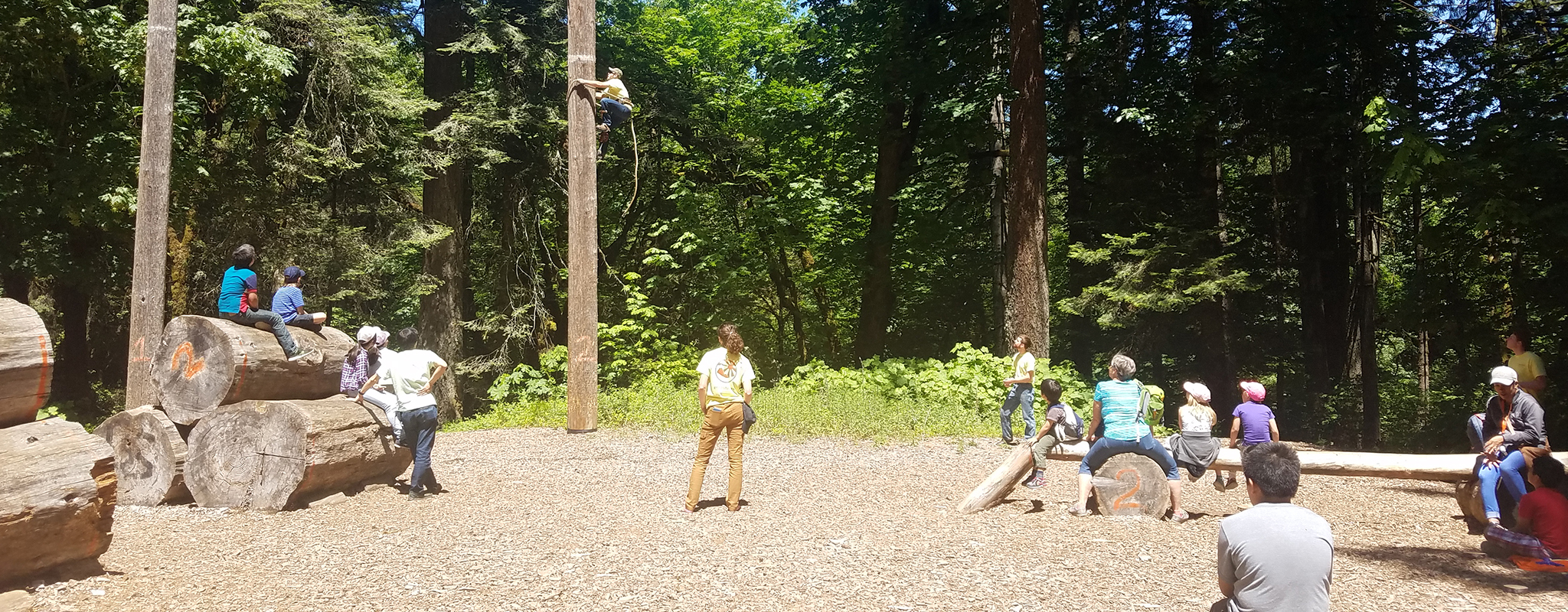
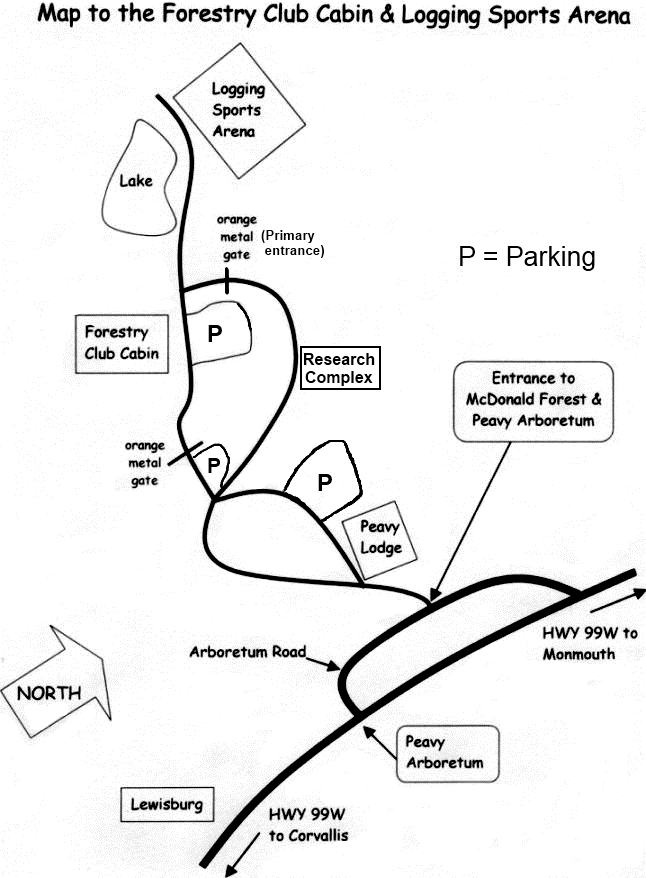
The Logging Sports Team is a Department Student Organization (DSO), sponsored by the Forest Engineering, Resources and Management department. While hosted by the College of Forestry, registration is open to all OSU students, whether you’re brand new or already have experience. Twice a year, in the fall and spring, the team hosts intramural meets near Peavy Arboretum. These meets are a great way to try out different events, meet the team, and get involved in a fun, supportive environment. All practices take place in the Logging Sports Arena, located in Peavy Arboretum. Carpool is available.
During the school year, there may be opportunities for the team to travel to competitions around the Western U.S. This could include unsanctioned regional competitions, as well as meets sanctioned by the American Lumberjack Association across the U.S., and some even traveling to Canada. Each year, one school in the Association of Western Forestry Clubs hosts the annual Conclave, which includes the Western Collegiate Logging Sports Championship. For more information about Logging Sports, please contact Ezra Pero or Sidney Williams.
Please note, participation in logging sports include a separate registration and is not automatic for those who join the Forestry Club.
Logging Sport Events
Axe Throw:
It’s like darts, but with axes. Competitors stand about 20 feet from a wooden target made of concentric scoring rings. The bullseye is worth five points, with values decreasing as you move outward. Each participant throws three axes, and their total score determines their placing.
Birling (Log Rolling):
Often called log rolling, this event pits two competitors against each other on a floating log. Using quick footwork, each person tries to spin the log and throw their opponent off balance. Matches are typically best-of-three, and costume contests are sometimes added for fun.
Buck Sawing:
A nod to pre-chainsaw logging, this event challenges competitors to cut through a log as quickly as possible using a crosscut saw. Events include individual (single buck), same-sex pairs (double buck), and mixed teams (Jack-and-Jill buck).
Caber Toss:
Inspired by the traditional Scottish event, competitors throw a tapered log (caber) in an attempt to flip it end-over-end. OSU competitions use smaller cabers—typically 9 feet for men and 6 feet for women—but it still requires strength and technique. Scoring is based on distance and successful rotation, with three attempts per competitor.
Choker Race:
This fast-paced obstacle course tests speed, endurance, and control. Competitors start by removing a choker (a cable used in logging) from a log, carry it through a course, and return to reset it. Obstacles vary but may include log piles, balance elements, and other challenges. Losing balance means restarting that section.
Chopping:
In chopping events, competitors use axes to cut through logs positioned either vertically or horizontally. Events may be timed (speed chop) or judged on efficiency (hard hit, based on number of strikes). Success depends on technique, accuracy, and understanding wood grain.
Limber Pole:
This crowd-favorite water event features a long, flexible pole suspended over water. Competitors move out as far as possible before losing balance and falling in. Distance is measured in two-foot increments. It’s especially entertaining—sometimes with costumes—when the water is cold!
Technical Events:
In addition to physical events, competitors can test their forestry knowledge in four technical areas: dendrology (plant identification), wood identification, timber cruising, and traverse (surveying). Rules and formats may vary by competition.
Tree Climb (Pole Climb):
In this event, competitors race to climb a tall pole or tree—typically 50 feet for men and 30 feet for women—using climbing spikes, a belt, and a safety line. After reaching the top, climbers must descend under control. Top competitors can reach full height in under 10 seconds.
Faculty Advisor for Logging Sports and Woodcuts Teams – Brett Morrisette
Woodcuts
Firewood sales through the Woodcuts program are a primary source of funding for the Logging Sports Team. Under the leadership of current Woodcut Chairs John Orm and Colin Kennedy, members contribute their time by bucking, splitting, sorting, stacking, and delivering firewood. Firewood produced through the program is available for purchase by the general public.
For more information, please contact the Woodcut Chairs – John Orm and Colin Kennedy
You can also stay updated by visiting the Woodcuts Facebook page.
Faculty Advisor for Logging Sports and Woodcuts Teams – Brett Morrisette
Pictures
History
History Of The Forestry Club At Oregon State College
By H. I. Nettleton
1960
A four-year course in forestry was first offered at Oregon State College in the fall of 1906 within the Department of Botany and Forestry under the direction of the School of Agriculture.
Scarcely two months after the fall term started, Professor E. R. Lake met one evening in his home with five forestry students, C. C. Gate, L. H. Stone, B. B. Totten, H. L. Currin and A. B. Mitchell. The purpose of the meeting was to establish a Forestry Club. The date was November 16, 1906.
Every forestry student was considered a member of the club. Meetings were held bi-monthly and on December 21, 1906, the Club's first Constitution was adopted.
Early meeting were held in Professor Lake's home, in the Agriculture Building and in what was then Avery Woodlot, now Avery Park. The open park meetings were usually bonfire affairs. Access to the park was by "Shanks' Mare", down the Southern Pacific railroad tracks, carrying refreshments in packsacks.
On December 6, 1907, Jack Pernot, who later lost his life on the Ochoco National Forest, moved that girls not be admitted to the club. Harvey Lickel counter-moved that Pernot's motion be laud on the table. So far as the records show, the motion is still there. On two occasions no meetings were held because the Professor forgot to bring his office keys!
On December 16, 1908, T. J. Starker moved that the Club design and adopt an official Forester's pin, and within the next four years an official pin and a pipe were adopted by its members, both involving a pine cone design. On that same date the first recorded mention was made of the need of encouraging indifferent members to attend Club meetings.
On April 6, 1910, when "T. J.", then better know as "Peach-fuzz", was Club president, a motion was made and passed requiring any member absent from a meeting to write a synopsis on some bulletin.
On April 11, 1912, James Evenden, later one of the famous "Iron Men" who contributed to mighty Michigan's upset defeat in football in 1915, moved that: "If any member of the Club is absent or very tardy and unable to give an acceptable excuse, a tax should be levied on such person." An amendment was added by Lynn Cronemiller, later to become Oregon's State Forester, "that the tax should be 'two bits' and, in case of 'fussing' - 'four "bits!'".
At the beginning of the second semester in February, 1910, George W. Peavy was appointed Professor of Forestry and head of the newly independent Department of Forestry. There were seventeen students at that time, all members, in more or less good standing, of the Forestry Club. Four of them, Harold D. Gill, Jack F. Pernot, Thurman J. Starker and Sinclair A. Wilson constituted the first graduating class in June, 1910.
On July 19, 1913, the Department of Forestry became the School of Forestry, and in the spring of 1916 the Forestry Club met and officially broke ground for a new Forestry Building which was first occupied the following fall.
Classes and Club neetings, up to that time, had been held on the third or 'heaventh' floor of the then Science Building, more familiarly known as the "chem-shack."
When the United States entered World War I in the spring of 1917, a Club meeting was held around a bonfire in Avery Woodlot. Almost half of the forestry student body (and Forestry Club) (49.5%) voted to enter the Armed Forces. Seniors were guaranteed their diplomas in absentia. Three gave their lives: Earl B. Blacken, Owen Johnson and Richard K. Wilmot. In the fall of 1924 the Forestry Club planted and dedicated three scarlet oaks at the southeast corner of the Forestry Building to the memory of these three men.
Shortly after the end of World War I, in the spring of 1920, the Club published its first annual, called the "Forest Club Annual." Later, in the fall of 1920, the Club initiated a contest to find a more appropriate name for its publication. Roger D. Healy, then a junior in forestry, suggested "The Annual Cruise" and that name was adopted.
Contents of the Annuals throughout the years reflect the changes in forestry methods, in clothing worn by foresters and in equipment used in logging. The first Annuals devoted much space to railroad logging, soon to be followed by truck logging, and the advertising space in the first editions listed Lidgerwood High Spar Skidders, Simonds cross-cut saws, Bergman's logging boots and Patrick Mackinaws.
During those earlier days, from 1913 to 1927, there were only two major courses of study offered: General Foresters and Logging Engineering. A deep rivalry developed between the students taking the two courses, intensified by the general feeling within the industry and outside the 'Walls of Learning' that foresters and loggers were entirely different breeds of cats and that "never the twain should meet" - at least amicably!
Students specializing in General Forestry looked down upon students specializing in Logging Engineering as a lower form of 'homo sapiens', given to profanity and snoose chewing and entirely lacking in any appreciation of trees in any form except logs. The "Loggers" took a keen delight in referring to the "Foresters" as a bunch of panty-waist idealists who were not "men enough to chew snoose without getting 'green around the gills'."
Feeling between the factions gradually become so intense that the Logger threatened to withdraw from the Forestry Club and start a Loggers Club of their own. About this time, in 1920, Harry R. Patterson arrived to head Logging Engineering. With his aid and some strong talk by Dean Peavy to both factions in a memorable Club meeting, the widening breach was healed and civil war averted.
One factor which contributed to the reunion of the foresters and loggers was the necessity of presenting a united front against their arch rivals, the lowly "muckers" from the School of Mines, then existing on the campus. The annual football game between selected representatives of the Forestry Club and the Miners Club, usually played in ankle deep mud, was an outstanding fall athletic event, vociferously backed by staff and club members of each school. Nothing was barred except pistols and knives and, if a miner or a forester failed to show for classes the day after this bloody affair, it was assumed that the corpus delicti was buried in the mud and might as well be left there until spring! The foresters, incidentally, won more than their share of the games.
In those earlier days, from 1910 to 1924, inclusive, the entire student body of the School moved off the campus for spring field trips. The first trip occurred in the spring of 1910 and included seven foresters: Harold D. Gill, Jack F. Pernot, Thurman J. Starker, Sinclair A. Wilson, Harold H. Barber, Howard J. Eberly, and Adolf Nelsson. These students, unaccompanied by a staff member, journeyed to the camps of the Columbia Timber Company above Goble, Oregon. They worked thier field problems from an outline.
It is presumed that the written reports of these "independent" studies were most carefully scanned by Professor Peavy upon the return to the campus of the "Saltation Seven" (meaning they made their way over the hills along the Columbia River by a series of leaps--from which may have developed the term long since applied to all Oregon State forestry students--Fernhoppers).
The next recorded all-school field trip in may of 1920 was a memorable one. The school owned no transport facilities at that time, so army trucks from the Military Department moved some fifty-odd (and some of them were) foresters to the mouth of Rock Creek Canyon near the east base of Mary's Peak. From there an escort wagon, drawnby two big army mules, moved the tentage and food supplies for a six day cruise to the forks of Rock Creek where "Hobo Camp" was established. So ended the first day--on a Saturday--at that.
The next day, Sunday, was spent--can you guess it--on last minute instructions on how to cruise timber and on crew organization--a foresters' "Sunday School." In the next six days a twenty percent strip cruise was made, covering four sections of timber in what is now the Corvallis watershed. Four strips were run per forty, each one chain wide. Seven man crews were used with duties as follows: 1. Chain of party, usually a senior student. 2. Topographer, usually a junior student. 3-4. Two cruisers, one on each side of strip center line--juniors. 5. Compassman, usually a sophomore. 6. Head chian and tally-man--freshman student. 7. Rear chainman--freshman student. Control lines were run and staked with elevations every five chains by Patterson's logging engineering crew.
On the last morning of this memorable trip, John W. Allan of the class of '23 posted a sign in front of his tent stating that he had a champion hot-cake eater in his squad who would contest against any man in camp, stakes to be cigars for the entire crew.
Dean Peavy promptly accepted the challenge, stole Allan's sign and re-erected it in front of his own tent. Allan named Gilbert D. Morgan, class of '23, as his man. Peavy named Sam S. Allen, also calss of '23 as his. The contest was to take place that evening, and then Peavy promptly assigned his man to remain in camp that day and cut up and stack a cord of wood as pre-training. Sam wasn't too much good out on the line, anyway, weighting around 250 pounds and none of that lean meat.
That evening a long trench fire was built and allowed to burn down to a fiery bed of hot coals. Four fry-pans of equal dinner plate size and an official batter ladle were selected, and a judge was named to preside over the baking of the hot-cakes to assure that each cake was edible and not a “raw-dab.” Each contestant selected a second to preside at his table to butter and syrup the hot cakes and two staff members were appointed to keep an official tally of the number of cakes eaten by each contestant. Practice baking stared at 7:30 P.M. to enable the four official bakers to perfect their techniques. Promptly at 8:00 P.M. each contestant was served his first hot-cake and the race was on, with the camp evenly divided in support of each, and equally vociferous in that support. Thirty minutes and eighteen hot-cakes later, Sam Allen arose from his table on the outside of eleven and Morgan staggered away with only seven beneath his belt. Cigars for the crowd by John Allan.
This same Sam Allan also made a record trip from camp to Buck’s place one evening when smoke showed over the ridge to the southwest shortly after supper time. The Dean promptly called the crew into emergency session and someone asked, with tongue in cheek, if there was any garden hose in camp. Peavy answered with tongue in cheek that there should be some at Buck’s place, three miles down the creek.
Whereupon Sam, all 250 pounds of him, quickly volunteered to go down and make arrangements for Buck to pack the hose into camp. Ed Sweeney hid in the brush below camp and did such a good job of cougar screaming as Sam passed on his return trip that Sam failed to make the turn onto the foot log across Rock Creek and fell, steaming, into the icy waters below.
During the spring of 1917 the seniors of the School of Forestry organized a local honorary forestry fraternity known as Sigma Lambda Epsilon. Due to World War I, nothing further was done until the fall of 1920 when several alumni, headed by Carl Jacoby ’17, initiated Joseph Steele and Harry Nettleton into the local as on-campus members to start negotiating for a local chapter of Xi Sigma Pi, National Honorary Forestry fraternity.
Forms and Helpful Links
Connect with the Forestry Club on Twitter
Connect with the Forestry Club on Instagram
American Lumberjack Association
Associated Oregon Loggers
Bailey's Logging Supply
Forestry Suppliers, Inc.
Lumberjack World Championships
North American Lumberjack Guide
Oregon Logging Conference
Society of American Foresters